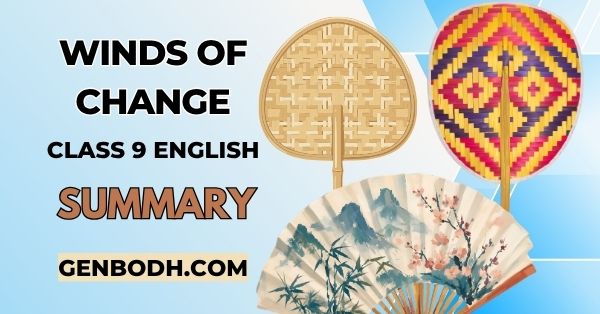
Winds of Change Chapter 3 Summary Class 9 is very good guide that can be used to prepare for examinations effectively. This chapter explores the history, cultural importance, regional diversity, and changing role of traditional Indian hand fans or pankhas. The chapter also connects pankhas with India’s past.
Chapter 3 Winds of Change Class 9 Summary
Meaning and Origin of Pankha
The word pankha or punkha originates from the word “pankh”, meaning the feather of a bird.
- Pankha is used as a general term for fans.
- Pankhi refers to a small plumed fan used in ancient India.
- Evidence of pankhi can be found in the Buddhist wall paintings at Ajanta.
- These paintings date back to the 2nd century CE.
- Pankha designs can also be seen in embroidery, sculptures and carvings.
Use of Pankhas in Ancient India
In ancient India, pankhas had several important uses.
They were:
- Used in temples to fan deities.
- Used in royal courts to fan kings.
- Made in different sizes.
- Some were as small as two inches.
- Larger pankhas required the strength of a person’s full arm to move them.
Thus, pankhas were not merely ordinary household objects. They also had religious, royal and cultural significance.
Pankhas as Cultural Goods
With time, pankhas became significant cultural goods.
They were:
Distributed through trade routes.
Considered exotic and stylish.
Made differently in different villages and towns.
Designed using local materials.
Decorated with intricate patterns.
Although pankhas were commonly used throughout India, their appearance and construction varied from region to region.
Important Concept
Same purpose + different regional designs = India’s cultural diversity
This is one of the most important ideas of the chapter.
Materials Used for Making Pankhas
Different regions used different materials according to their local resources, culture and traditions.
Some materials mentioned in the chapter are:
- Bamboo
- Cane
- Palm leaves
- Silk
- Brass
- Leather
- Silver
- Beads
- Grass
- Gold thread
- Zari
- Satin
The choice of materials and designs depended on geography, culture and traditional rituals.
Regional Varieties of Pankhas
Rajasthan
Rajasthan has several distinctive varieties of pankhas.
Appliqué Hand Fan
- Made using pieces of fabric.
- Fabrics are arranged in different shapes and patterns.
- They are sewn onto another cloth.
- Ornamental needlework is used.
Zardozi Hand Fan
- Known for ornate decoration.
- Uses glittering and elaborate gold threadwork.
- Represents the rich decorative tradition of Rajasthan.
Temple Hand Fan
- Made by engraving brass.
- Has a long handle.
Painted Hand Fan
- Made from cardboard.
- Features various painted images.
- Usually offered to gods.
Gujarat
Gujarat also has its own indigenous varieties of pankhas.
Mirror-Work Hand Fans
- Made using pure cotton.
- Decorated with mirror work.
- Reflect Gujarat’s traditional decorative craft.
Beads Hand Fan
- Covered with colourful beads.
- Has a silver handle.
- Commonly used as a wall decoration.
Kutch Leather Hand Fans
- Made from leather.
- Hand-stitched.
- Decorated with thread and wool along the seams.
West Bengal
Artisans in Bengal make delicate pankhas using the milky-white spongy centre of sola (a type of water grass).
Tal Patar Pankha
- Made from palm leaves.
- Locally known as Tal Patar Pankha.
- Easy to carry.
- Traditionally kept in Bengali households as an article of possession.
Uttar Pradesh
The Phadh hand fans of Uttar Pradesh are decorated with:
- Pure gold
- Silver zari
- Silk
- Satin frills
These materials make them highly decorative traditional craft objects.
Odisha
Odisha is known for its large palm-leaf fans.
They are recognised across India for their:
- Antiquity
- Traditional character
- Rarity
Bihar
Bihar is known for its colourful and sturdy bamboo hand fans.
Tribal Communities and Pankhas
Many tribes in India have adopted pankha-making as a handicraft and developed their own versions.
They use:
- Grass
- Metal
- Bamboo sticks
- Cane
- Palm leaves
- Silk
- Brass
They also use geometrical patterns and combinations such as white ink on a red background to create distinctive designs.
This shows that traditional crafts can change while still retaining their cultural roots.
Changing Role of Pankhas
One of the most important themes of the chapter is the changing role of pankhas.
Earlier
Pankhas were made mainly for personal use and were used to provide air.
Later
With the development of modern technology and innovative creations, their practical use declined.
Today
Traditional pankhas are mainly used as:
- Decorative objects
- Traditional craft items
- Cultural objects
- Products sold by artisans
The craft has gradually transformed into a commercial business and now provides some form of livelihood to Indian artisans.
Threat from Modern Technology
The advancement of technology has created a challenge for traditional pankha-making.
Modern alternatives have reduced the need for traditional hand fans in everyday life. As a result, the beautiful culture surrounding pankhas is at risk of slowly losing its presence among Indians.
However, new designs and different versions of pankhas have contributed to a slight increase in popularity and demand.
Hard Words
| Hard Word | हिंदी अर्थ | Simple English Meaning |
|---|---|---|
| Indigenous | स्थानीय / किसी विशेष स्थान से जुड़ा हुआ | Native to a particular place |
| Innovative | नए तरीके से किया गया / नवीन | New and original in approach |
| Industrious | मेहनती / परिश्रमी | Hardworking |
| Intricate | बारीकी और जटिलता से बना | Elaborate and detailed |
| Invoked | किसी भावना को उत्पन्न किया | Brought out a feeling |
| Initiatives | किसी सुधार के लिए उठाए गए कदम | Actions taken to improve a situation |
| Artefact | हस्तनिर्मित या ऐतिहासिक वस्तु | An object made by people, often of cultural value |
| Craftspersons | कारीगर / हस्तशिल्प बनाने वाले लोग | People skilled in making things by hand |
| Pankhi | प्राचीन समय का छोटा पंखा | A small plumed fan used in ancient India |
| Plumed | पंखों से सजाया हुआ | Decorated with feathers |
| Evidence | प्रमाण / सबूत | Proof that shows something existed or happened |
| Deities | देवी-देवता | Gods or divine figures |
| Royal courts | राजाओं के दरबार | Places where kings held court |
| Exotic | अनोखा और विशेष | Unusual and attractive because of its origin |
| Substantial | काफी मात्रा में / पर्याप्त | Large or considerable |
| Commonality | समानता / एक जैसी विशेषता | A feature shared by different things |
| Varieties | अलग-अलग प्रकार | Different kinds or forms |
| Distinct | स्पष्ट रूप से अलग | Clearly different |
| Geographies | भौगोलिक परिस्थितियाँ | Physical features and conditions of a region |
| Rituals | पारंपरिक धार्मिक रीति-रिवाज | Traditional religious practices |
| Antique | बहुत पुराना और ऐतिहासिक महत्व वाला | Old and valuable because of age |
| Appliqué | कपड़े पर अलग कपड़े का डिजाइन सिलने की कला | A decorative technique using pieces of fabric |
| Ornamental | सजावटी | Used for decoration |
| Needlework | सुई-धागे से किया गया काम | Decorative work done with a needle and thread |
| Zardozi | सोने-चाँदी की ज़री से की जाने वाली सजावट | Decorative embroidery using metallic thread |
| Ornate | बहुत सजावटी और अलंकृत | Highly decorated |
| Encrusted | सजावटी वस्तुओं से ढका हुआ | Covered or decorated with something |
| Engraving | सतह पर नक्काशी करना | Cutting a design into a hard surface |
| Cardboard | गत्ते का मजबूत कागज | Thick, stiff paper material |
| Embellished | सजाया हुआ / अलंकृत | Decorated with additional details |
| Beads | मोती या छोटे सजावटी दाने | Small decorative objects with a hole |
| Dainty | नाजुक और सुंदर | Small, delicate and attractive |
| Seams | सिलाई की जुड़ी हुई रेखा | Lines where pieces of material are joined |
| Embroidered | कढ़ाई किया हुआ | Decorated with stitched designs |
| Cross-stitch | क्रॉस के आकार में टांके लगाने की कढ़ाई | A type of embroidery using crossed stitches |
| Delicate | बहुत नाजुक | Easily damaged or broken |
| Sola | एक प्रकार की जलघास | A type of water grass |
| Perpetually | लगातार / हमेशा | Constantly |
| Possession | अपने पास रखी हुई वस्तु | Something owned or kept by someone |
| Phadh | उत्तर प्रदेश का पारंपरिक हस्तपंखा | A traditional hand fan from Uttar Pradesh |
| Zari | धातु के धागे से की गई सजावट | Decorative metallic threadwork |
| Frills | कपड़े की सजावटी झालर | Decorative strips of gathered fabric |
| Sturdy | मजबूत और टिकाऊ | Strong and durable |
| Antiquity | बहुत पुराना इतिहास / प्राचीनता | The distant past |
| Rarity | दुर्लभता | The quality of being uncommon |
| Adopted | अपनाया / स्वीकार किया | Took up or accepted |
| Embedded | किसी चीज के भीतर लगाया हुआ | Fixed firmly into something |
| Geometrical | ज्यामितीय आकारों से संबंधित | Related to shapes such as circles and squares |
| Advent | आगमन / शुरुआत | Arrival of something new |
| Commercial | व्यापार से संबंधित | Related to buying and selling |
| Livelihood | आजीविका / कमाई का साधन | A means of earning a living |
| Contemporary | वर्तमान समय से संबंधित | Belonging to the present time |
| Sustainable | लंबे समय तक चलने योग्य | Able to continue for a long time |
| Artistry | कला-कौशल | Skill and creativity in making art |
| Preserve | सुरक्षित रखना / बचाए रखना | To protect something from being lost or damaged |
| Appreciating | महत्व और सुंदरता को समझना | Recognising the value of something |
| Craftsmanship | हस्तकला बनाने का कौशल | Skill in making things by hand |