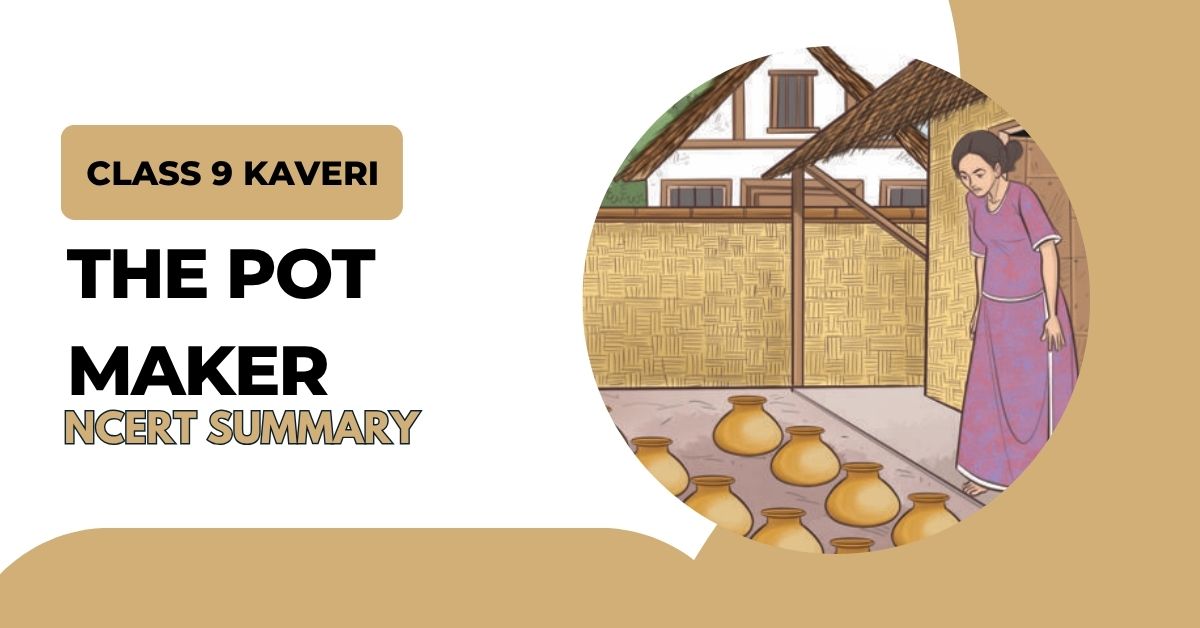
The Pot Maker revolves around Sentila, a young girl who dreams of becoming a pot maker despite facing challenges and lack of support from her mother. Through her journey, Class 9 students learn valuable lessons about hard work, determination, and the significance of cultural heritage.
Detailed Summary of The Pot Maker Class 9 Kaveri
The chapter The Pot Maker is about a young girl named Sentila, who dreams of becoming a pot maker like her mother and grandmother. From a young age, she is deeply interested in pottery and secretly learns by observing expert potters in her village.
However, her mother Arenla does not want her to learn this craft. She believes that pot making is very hard work and gives very little money. She explains that collecting clay from faraway riverbanks, carrying heavy loads and shaping pots is tiring and time consuming. Instead, she wants Sentila to learn weaving, which is easier and more profitable.
However, Sentila continues to follow her passion secretly. She watches potters carefully and becomes fascinated by how a simple lump of clay turns into a beautiful pot. She learns the entire process from preparing clay to shaping and firing pots in a kiln.
Soon, the villagers notice her interest and question why Arenla is not teaching her daughter. The village elders remind Sentila’s father Mesoba that such traditional skills should be passed on to the next generation because they are part of the community’s culture and heritage.
After this, Arenla finally agrees to teach Sentila. She takes her to the riverbank and teaches her how to collect and prepare clay. Although Sentila learns quickly at first, she struggles with shaping the pots. Even after practicing for a year, she feels frustrated and unable to succeed.
Later, Sentila meets a kind woman named Onula, who understands her problem. Onula notices that Sentila is too tense while working. She teaches her to relax and guides her patiently. With Onula’s help, Sentila finally manages to make a proper pot and gains confidence.
After this, Sentila starts observing her mother more carefully, especially the finer details of shaping pots. One day, Arenla pretends to be unwell and leaves the work to Sentila. Surprisingly, Sentila works with confidence and skill, making many beautiful pots almost equal to her mother’s work.
However, this moment of success is mixed with tragedy. When Sentila goes to call her mother, she finds that Arenla has died. Sentila feels emotional and regrets that her success came at such a painful time.
Later, Onula sees two rows of pots in the shed, one made by Arenla and the other by Sentila but they look exactly the same. She realizes that Sentila has truly mastered the art. The story ends with the line “A new pot maker was born,” showing that Sentila has finally become a skilled potter and continues the tradition.
Character Sketches of The Pot Maker Class 9
Sentila (Main Character)
Sentila is a young girl who is passionate and determined. From childhood, she dreams of becoming a pot maker like her mother and grandmother. She is very curious and learns by observing others carefully. Even when her mother does not support her, she secretly continues to follow her passion.
She is also hardworking and patient. Although she fails many times while learning pottery, she does not give up. With practice and guidance from Onula, she improves her skills. Sentila is respectful and emotional, as shown when she feels sad after her mother’s death.
Arenla (Sentila’s Mother)
Arenla is a skilled pot maker but a practical and hardworking woman. She has faced many difficulties in her life, which makes her believe that pottery is not a good profession. She wants her daughter to learn weaving because it is easier and more profitable.
Although she appears strict, she cares deeply for Sentila. Later, she agrees to teach her pottery. Her actions show that she wants a better future for her daughter.
Onula (The Guide)
Onula is a kind, wise, and helpful woman. She understands Sentila’s problem and guides her with patience. She teaches her the right way to make pots and encourages her to stay calm and confident. She plays an important role in Sentila’s success. Without her support, Sentila might not have learned pottery properly.
Mesoba (Sentila’s Father)
Mesoba is a calm and understanding person. He supports his daughter and respects the village traditions. When the village council questions him, he responds politely and wisely. He acts as a bridge between the villagers and his family and helps maintain harmony.
Hindi Summary
यह कहानी एक लड़की सेंटिला (Sentila) की है, जो बचपन से ही अपनी माँ और दादी की तरह कुम्हार (मिट्टी के बर्तन बनाने वाली) बनना चाहती है। उसे मिट्टी के बर्तन बनाने का बहुत शौक होता है और वह छुपकर गाँव के कुम्हारों को देखकर सीखने की कोशिश करती है।
लेकिन उसकी माँ अरेनला (Arenla) नहीं चाहती कि वह यह काम सीखे, क्योंकि यह बहुत कठिन और कम कमाई वाला काम है। अरेनला चाहती है कि सेंटिला बुनाई सीखे, जिससे ज्यादा पैसा मिलता है और काम भी आसान होता है।
फिर भी सेंटिला अपने सपने को नहीं छोड़ती। वह ध्यान से देखती है कि कैसे मिट्टी को गूँथकर, आकार देकर और भट्ठी में पकाकर सुंदर बर्तन बनाए जाते हैं। उसकी लगन देखकर गाँव के लोग भी चाहते हैं कि उसे यह कला सिखाई जाए, क्योंकि यह उनकी परंपरा का हिस्सा है।
आखिरकार, अरेनला सेंटिला को सिखाने के लिए तैयार हो जाती है। वह उसे नदी से मिट्टी लाना और उसे तैयार करना सिखाती है। सेंटिला जल्दी सीख जाती है, लेकिन बर्तन का आकार बनाने में बार-बार असफल होती है। एक साल तक कोशिश करने के बाद भी वह सफल नहीं हो पाती और निराश हो जाती है।
तभी उसकी मुलाकात ओनुला (Onula) नाम की एक दयालु महिला से होती है, जो उसे सही तरीके से और धैर्य के साथ काम करना सिखाती है। ओनुला की मदद से सेंटिला का आत्मविश्वास बढ़ता है और वह अच्छे बर्तन बनाने लगती है।
एक दिन अरेनला उसे अकेले काम करने के लिए छोड़ देती है। सेंटिला पूरे आत्मविश्वास के साथ कई सुंदर बर्तन बना लेती है, लगभग अपनी माँ जितने अच्छे। लेकिन जब वह अपनी माँ को बताने जाती है, तो उसे पता चलता है कि उसकी माँ की मृत्यु हो चुकी है। यह उसके लिए बहुत दुखद क्षण होता है।
बाद में, ओनुला देखती है कि सेंटिला और उसकी माँ के बनाए बर्तनों में कोई अंतर नहीं है। इससे यह साबित होता है कि सेंटिला अब एक कुशल कुम्हार बन चुकी है। कहानी का अंत इस वाक्य से होता है, “एक नया कुम्हार जन्म ले चुका था।”
Hard Words Meanings
| Word | Hindi Meaning | English Meaning |
|---|---|---|
| Outgrow | रुचि खत्म हो जाना | To lose interest as one grows older |
| Indifference | उदासीनता | Lack of interest or concern |
| Pittance | बहुत कम पैसा | A very small amount of money |
| Pounding | कूटना / पीटना | Repeated hitting or beating |
| Tedious | थकाने वाला | Boring and tiring |
| Deftly | कुशलता से | Skillfully |
| Spatula | औजार (मिट्टी आकार देने के लिए) | Tool used to shape clay |
| Kiln | भट्ठी | Oven used to bake pots |
| Tend | देखभाल करना | To take care of |
| Followed suit | दूसरों जैसा करना | To do the same as others |
| Dao | मिट्टी खोदने का औजार | Tool used for digging |
| Malleable | आसानी से आकार लेने वाला | Easily shaped without breaking |
| Dormitories | छात्रावास | Large rooms with many beds |
| Resolved | निश्चय किया | Determined firmly |
| Clumsy | अनाड़ी | Awkward and unskilled |
| Wearily | थके हुए तरीके से | In a tired manner |
| Slackened | धीमा करना | To slow down |
| Momentum | गति की शक्ति | Force that keeps moving |
| Dexterity | कुशलता | Skill in using hands |
| Tally | गिनती | Total count |
| Threshold | दहलीज | Entrance of a doorway |
| Intuitively | सहज रूप से | Understanding without reasoning |
| Momentous | महत्वपूर्ण | Very important |
| Phenomenon | असामान्य घटना | Something unusual |
| Profound | गहरा | Deep and meaningful |
| Revelation | अचानक समझ | Sudden realization |