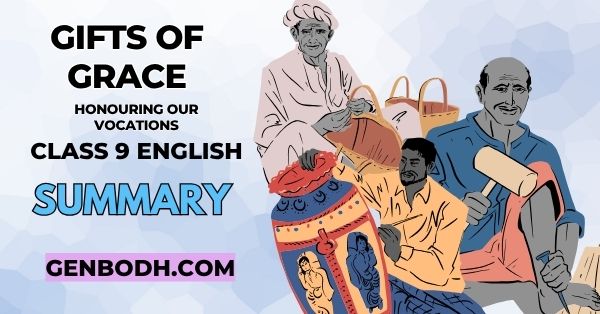
Gifts of Grace Honouring Our Vocations Class 9 Notes is very helpful if you want to understand the chapter in efficient manner. This poem celebrates the dignity, skill and importance of different kinds of work. It presents Bharat as a place where people belonging to different vocations perform their duties with pride, creativity and dedication. It mentions several workers and professionals, including craftspersons, artisans, carpenters, electricians, boatmen, shoemakers, cooks, designers and masons.
Gifts of Grace Honouring Our Vocations Summary Class 9 English
Stanza 1
I hear Bharat celebrating, the varied vocations I hear;
Those of craftsperson, each one celebrating their
craft, woven with colours and myriad hues.
Explanation
The poet begins by imagining Bharat as a place filled with the sounds of people engaged in different occupations. The phrase “varied vocations” draws attention to the diversity of work found in society. The poet particularly notices the craftspersons who take pride in their traditional skills.
Their crafts are described as being “woven with colours and myriad hues”, suggesting that their work is full of beauty, creativity and variety. The poet does not look at craft merely as a profession; it is presented as an expression of skill and cultural richness.
हिंदी में भावार्थ
कवि कविता की शुरुआत भारत में मौजूद विभिन्न प्रकार के व्यवसायों और कामों की ओर ध्यान दिलाते हुए करता है। उसे ऐसा महसूस होता है जैसे पूरा भारत अपने लोगों के अलग-अलग कामों का उत्सव मना रहा हो। कारीगर अपने-अपने हुनर पर गर्व करते हैं और उनकी कला अनेक रंगों, रूपों और सुंदरताओं से भरी हुई है। “myriad hues” के माध्यम से कवि शिल्पकला की विविधता और समृद्धि को सामने लाता है। इस प्रकार शुरुआत से ही कविता यह विचार प्रस्तुत करती है कि अलग-अलग व्यवसाय भारत की सामाजिक और सांस्कृतिक विविधता का महत्वपूर्ण हिस्सा हैं।
Hard Words
| Word | English Meaning | Hindi Meaning |
|---|---|---|
| Bharat | India | भारत |
| celebrating | expressing joy or appreciation | उत्सव मनाना / खुशी व्यक्त करना |
| varied | different; diverse | विविध / अलग-अलग |
| vocations | occupations or professions | व्यवसाय / पेशे |
| craftsperson | a skilled person who makes things through a craft | कुशल कारीगर |
| craft | a skilled artistic activity | शिल्प / कला-कौशल |
| woven | closely combined or joined | बुना हुआ / आपस में जुड़ा हुआ |
| myriad | a very large number | असंख्य / बहुत बड़ी संख्या |
| hues | shades or varieties of colour | रंगों की छटाएँ |
Poetic Features
- Personification – “Bharat celebrating”
Bharat is presented as if it were a person capable of celebrating. - Visual Imagery – “colours and myriad hues”
These words create a colourful mental picture of the crafts produced by the craftspersons. - Repetition – “I hear”
The phrase “I hear” appears at the beginning and becomes an important recurring expression in the poem. - Alliteration – “varied vocations”
The repetition of the ‘v’ sound gives the phrase a rhythmic quality. - Symbolism
The different crafts symbolise the diversity and richness of Bharat.
Stanza 2
The artisans with lutes, each hailing varied
emotions and celebrating dreams, echoing in
the streets.
Explanation
The poet now turns towards artists who play the lute, a musical instrument. Their music carries different emotions and expresses their dreams. Their artistic expressions are not restricted to private spaces; their music echoes through the streets, becoming part of the wider life of the community.
The poet therefore presents art as a powerful way of expressing feelings and aspirations. The sound of the lute also adds a musical quality to the poem itself.
हिंदी में भावार्थ
इसके बाद कवि उन कलाकारों का वर्णन करता है जो ल्यूट जैसे वाद्य यंत्र बजाते हैं। उनके संगीत में अलग-अलग भावनाएँ और उनके सपने व्यक्त होते हैं। उनका संगीत केवल उनके व्यक्तिगत संसार तक सीमित नहीं रहता, बल्कि गलियों में गूँजता हुआ लोगों तक पहुँचता है। इस प्रकार कवि कला को भावनाओं, कल्पनाओं और आकांक्षाओं को व्यक्त करने का माध्यम बताता है।
Hard Words
| Word | English Meaning | Hindi Meaning |
|---|---|---|
| artisans | skilled workers, especially those making things by hand | कुशल कारीगर / शिल्पकार |
| lutes | stringed musical instruments | तार वाला वाद्य यंत्र |
| hailing | expressing or presenting | व्यक्त करना / प्रकट करना |
| varied | different; diverse | विविध / अलग-अलग |
| emotions | strong feelings | भावनाएँ |
| celebrating | expressing joy or appreciation | उत्सव मनाना / सराहना करना |
| dreams | hopes and aspirations | सपने / आकांक्षाएँ |
| echoing | producing or carrying a repeated sound | गूँजना |
| streets | public roads or lanes | गलियाँ / सड़कें |
Poetic Features
- Auditory Imagery – “lutes” and “echoing in the streets”
The poet creates an impression of music spreading through the streets. - Personification – “celebrating dreams”
Dreams are presented as something that can be celebrated. - Symbolism
The music symbolises the emotions, dreams and creativity of the artists. - Enjambment
The thought continues from one line to the next without a complete pause, giving the stanza a flowing quality.
Stanza 3
The carpenters celebrating; they create anything
out of wood with mathematical precision,
The electricians humming; they get ready for work,
work with cables and wires to brighten our lives,
Explanation
The poet next celebrates two occupations – carpenters and electricians.
Carpenters are praised for their ability to transform wood into useful objects. Their work requires great accuracy and measurement, which is why the poet describes it as being done with “mathematical precision.”
The electricians are shown humming while preparing for work. Their work with cables and wires helps bring electricity and light into people’s lives. The expression “brighten our lives” has both a literal and an imaginative meaning: electricians help provide physical light while their work also contributes to people’s comfort and daily life.
हिंदी में भावार्थ
इस हिस्से में कवि बढ़ई और इलेक्ट्रिशियन जैसे काम करने वाले लोगों की उपयोगिता को सामने लाता है।
बढ़ई लकड़ी को काटकर और आकार देकर अलग-अलग उपयोगी वस्तुएँ बनाते हैं। इसमें थोड़ी-सी गलती भी पूरे काम को प्रभावित कर सकती है, इसलिए उनके काम में सटीक माप और सावधानी बहुत जरूरी है। “Mathematical precision” उनके इसी कौशल को दर्शाता है।
इलेक्ट्रिशियन तारों और केबलों के साथ काम करते हैं और उनकी मेहनत से हमारे घरों और आसपास बिजली तथा रोशनी की सुविधा मिलती है। इसलिए कवि उनके काम को हमारे जीवन को “brighten” करने वाला बताता है।
Hard Words
| Word | English Meaning | Hindi Meaning |
|---|---|---|
| carpenters | people who work with wood | बढ़ई |
| create | make or produce something | बनाना / रचना करना |
| mathematical | related to exact calculation | गणितीय |
| precision | exactness and accuracy | सटीकता / शुद्धता |
| electricians | skilled workers who work with electrical systems | बिजली का काम करने वाले कुशल कर्मचारी |
| humming | making a low continuous musical sound | गुनगुनाना |
| cables | thick wires used for carrying electricity or signals | केबल / मोटे तार |
| wires | metal conductors used to carry electricity | तार |
| brighten | to make lighter or more cheerful | रोशन करना / उज्ज्वल बनाना |
Poetic Features
- Metaphorical Expression – “brighten our lives”
Electricians literally help provide light, while the expression also suggests the comfort and convenience their work brings to life. - Auditory Imagery – “electricians humming”
The reader can imagine the soft sound of workers humming while doing their work. - Visual Imagery
The reference to wood, cables and wires creates pictures of the workplaces and activities of the workers. - Personification – “carpenters celebrating” / “electricians humming”
The occupations are presented through lively human actions, making the workers’ activities feel energetic and joyful.
Stanza 4
The boatmen gathering their nets from the shore,
sailing, and singing while at work, return to tell
the tales of life at sea,
The shoemakers affirming the quality of their
work, for the feet that walk, dance, run, jump,
return home.
Explanation
The poet now describes the lives of boatmen and shoemakers.
The boatmen collect their nets from the shore and go sailing. Even while doing demanding work, they sing. When they return, they have stories and experiences from their life at sea to share. Their occupation is therefore shown as a combination of hard work, experience and a connection with the sea.
The poet then praises shoemakers for the quality of the footwear they produce. Shoes support people in many activities – walking, dancing, running and jumping and eventually accompany them back home. Through this description, the poet shows how an apparently ordinary occupation has a direct connection with people’s everyday lives.
हिंदी में भावार्थ
अब कवि समुद्र से जुड़े boatmen और जूते बनाने वाले shoemakers का चित्र प्रस्तुत करता है।
नाविक समुद्र के किनारे अपने जाल इकट्ठा करते हैं, नाव चलाते हैं और काम करते हुए गाते भी हैं। समुद्र में काम करने के कारण उनके पास अनेक अनुभव होते हैं, जिन्हें वे वापस लौटकर दूसरों के साथ साझा करते हैं। इससे उनके जीवन में मेहनत के साथ-साथ अनुभव और आनंद का भाव दिखाई देता है।
इसके बाद कवि shoemakers के काम की गुणवत्ता को महत्व देता है। उनके बनाए जूते लोगों के पैरों को चलने, नाचने, दौड़ने और कूदने में सहारा देते हैं। इस तरह कवि यह दिखाता है कि जूते बनाने वाले लोगों का काम भी हमारे रोज़मर्रा के जीवन का महत्वपूर्ण हिस्सा है।
Hard Words
| Word | English Meaning | Hindi Meaning |
|---|---|---|
| boatmen | people who operate or work on boats | नाविक |
| gathering | collecting | इकट्ठा करना |
| nets | materials used for catching fish | जाल |
| shore | land along the edge of a sea or river | समुद्र/नदी का किनारा |
| sailing | travelling by boat on water | नाव चलाना / नौकायन करना |
| tales | stories | कहानियाँ / किस्से |
| sea | a large area of salt water | समुद्र |
| shoemakers | people who make or repair shoes | जूते बनाने वाले कारीगर |
| affirming | declaring or showing confidently | दृढ़ता से दिखाना / पुष्टि करना |
| quality | standard or excellence of something | गुणवत्ता |
| feet | plural of foot | पैर |
| return | come back | वापस लौटना |
Poetic Features
- Visual Imagery – “nets from the shore”
The reader can picture boatmen collecting their nets beside the sea. - Auditory Imagery – “singing while at work”
The singing allows us to imagine the sounds accompanying the boatmen’s work. - Listing – “walk, dance, run, jump”
The poet lists several movements to emphasise the usefulness of footwear. - Repetition of ‘and’
The repeated conjunction in expressions such as “sailing, and singing” creates a flowing rhythm.
Stanza 5
The delicious singing of the cook, or the rhythm of
designer, mason, each celebrating what belongs to
them and to none else,
The voice of their vocation is the voice of their
identity. I hear Bharat celebrating, the varied
voices I hear!
Explanation
In the final section, the poet brings together more occupations, including cooks, designers and masons. The cook’s work is described through the unusual expression “delicious singing.” The poet connects the pleasure of food with the pleasure created by the cook’s work.
The rhythm associated with the designer and mason suggests the distinctive pattern, skill and creative process involved in their work. Each person takes pride in the work that belongs specifically to them.
The most important idea comes in the line “The voice of their vocation is the voice of their identity.” The poet suggests that a person’s work can become an important expression of who they are. The poem finally returns to the opening idea of hearing Bharat celebrating its many different voices.
हिंदी में भावार्थ
अंतिम हिस्से में कवि कुछ और व्यवसायों – cook, designer और mason को शामिल करता है। Cook के काम को “delicious singing” जैसे सुंदर और कल्पनात्मक तरीके से प्रस्तुत किया गया है। इसका अर्थ यह है कि उसके बनाए भोजन में वही आनंद और संतुष्टि महसूस होती है जैसी किसी मधुर संगीत में।
Designer और mason के काम में भी एक विशेष rhythm या व्यवस्थित रचनात्मकता दिखाई देती है। हर व्यक्ति अपने काम को अपनी विशेष पहचान और योगदान के रूप में देखता है।
इस पूरे हिस्से की सबसे महत्वपूर्ण बात यह है कि व्यक्ति का vocation उसकी identity से जुड़ जाता है। यानी इंसान जिस काम को अपने कौशल और लगन से करता है, वह काम उसके व्यक्तित्व और सामाजिक पहचान का एक हिस्सा बन सकता है।
अंत में कवि फिर से भारत की अलग-अलग vocations और उनकी अलग-अलग आवाज़ों को सुनने की बात करता है। इससे पूरी कविता एकता और विविधता के विचार पर समाप्त होती है।
Hard Words
| Word | English Meaning | Hindi Meaning |
|---|---|---|
| delicious | very pleasant to taste | स्वादिष्ट |
| singing | producing musical sounds with the voice | गाना / गायन |
| rhythm | a regular pattern of sound or movement | लय / ताल |
| designer | a person who plans or creates something | डिज़ाइन बनाने वाला व्यक्ति |
| mason | a skilled worker who builds with bricks, stone, etc. | राजमिस्त्री |
| belongs | is connected with or is the property of | संबंधित होना / अपना होना |
| vocation | occupation or profession | व्यवसाय / पेशा |
| identity | qualities that define a person | पहचान |
| varied | different; diverse | विविध / अलग-अलग |
| voices | sounds or expressions of people | आवाज़ें / अभिव्यक्तियाँ |
Poetic Features
- Metaphor – “The delicious singing of the cook”
The textbook specifically identifies this as a metaphor. The cook’s work is imaginatively associated with something “delicious,” connecting the enjoyment of food with the pleasure of music. - Metaphor – “The voice of their vocation is the voice of their identity”
“Voice” does not simply mean a person’s physical voice. It symbolically represents the person’s work, contribution and individuality. - Repetition
The opening idea “I hear Bharat celebrating…” is brought back at the end. This repetition reinforces the central idea of the poem and gives it structural unity. - Auditory Imagery – “singing” and “voices”
The poem ends with sound-related imagery, connecting the different occupations with their distinctive “voices.” - Personification – “Bharat celebrating”
Bharat is again presented as if it can celebrate the varied occupations of its people. - Symbolism – “voice of their identity”
The “voice” symbolises the unique contribution and identity associated with each vocation.