The decline and disintegration of the great Mughal Empire which had reached its zenith under strong rulers was the result of a multitude of interconnected factors originating with the policies of Aurangzeb and magnified by the incompetence of his successors and a crippling financial and administrative breakdown.
The Responsibility of Aurangzeb (1658–1707)
While the unity and stability of the empire were shaken during his long reign, Aurangzeb’s policies created long-term, detrimental effects:
Imperial Over-expansion: The Mughal Empire, particularly under Aurangzeb, expanded beyond the point of effective administrative control, resembling an “inflated balloon”. The vastness of the territory, coupled with the undeveloped means of communication, severely weakened the center.
The Deccan Wars and Financial Drain: Aurangzeb’s continuous policy of aggressive imperialism and prolonged war in the Deccan (lasting twenty-seven years) drained the imperial treasury, exhausted the Empire’s wealth, and ruined the region’s trade and industry. The immense expenditure forced him to melt down household silver and open the treasure houses of earlier emperors. This “Deccan ulcer” proved fatal to the Empire.
Religious Policies and Alienation: Aurangzeb’s attempt to restore the Islamic character of the state through religious orthodoxy, including the reimposition of the jizyah (1679) and the destruction of Hindu temples, provoked widespread discontent and rebellion. This policy alienated key reliable supporters like the Rajputs and fueled major uprisings among the Sikhs, Jats, Bundelas, and Marathas.
Maratha Resistance: Aurangzeb failed to accept the Maratha demand for regional autonomy and chose to suppress them instead turning the Maratha resistance into a national struggle for the defense of religion and liberties. The Maratha guerrilla tactics demoralized the Mughal armies and wore them out. The conquest of the Deccan sultanates (Bijapur and Golconda) also inadvertently removed a local check on Maratha activities, leaving them free to organize resistance against Mughal imperialism.
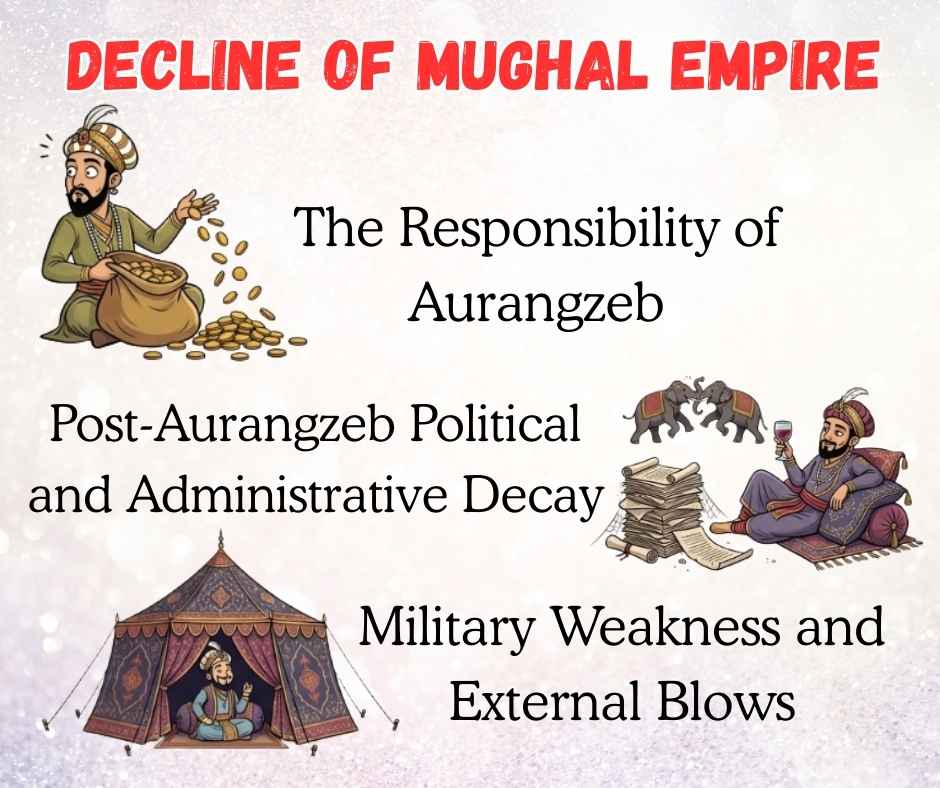
Post-Aurangzeb Political and Administrative Decay
After Aurangzeb’s death, the fragile system rapidly deteriorated:
Weak Successors and Monarchical Failure: Since the Mughal system was despotic, it relied heavily on the emperor’s personality. After Aurangzeb, subsequent emperors were weaklings, unable to maintain the empire’s prestige or integrity. Rulers like Bahadur Shah I (‘Shah-i-bekhabar’), Jahandar Shah, and Mohammad Shah (‘Rangila’) were characterized by indifference toward public affairs, addiction to luxury, and lax morals. The appointment of one-year-old babies as governors highlights the profound administrative foolishness during this period.
Defective Law of Succession and ‘King-Makers’: The absence of a fixed law of succession meant that the death of an emperor resulted in ruinous civil wars, making the sword the “grand arbiter of right”. Under the later Mughals, the struggle shifted from princes to powerful, ambitious nobles (like Zulfikar Khan and the Saiyid Brothers) who acted as ‘king-makers,’ using royal princes as mere pawns for their personal interests. This dynamic ensured the “survival of the weakest” prince and severely crippled the body politic financially and militarily.
Degeneration of the Nobility and Court Factions: Following the emperor’s example, the nobility degenerated, trading the hard life of military adventure for luxurious living, drinking, and gambling. They became selfish and disloyal, lacking devotion to the state. Influential nobles organized themselves into warring factions (e.g., Turani and Persian) that engaged in constant political unrest, fought battles, and even intrigued with foreign invaders, thereby prioritizing personal gain over national stability.
Financial and Jagirdari Crisis: The state’s financial condition steadily worsened due to the drain from Deccan wars and lavish imperial spending. As outlying provinces declared independence and stopped remitting revenue, the center became bankrupt. The Jagirdari crisis occurred because the land available for jagirs was insufficient for the growing number of nobles, leading to intense rivalry and forcing jagirdars to squeeze maximum revenue from peasants in their short tenures.
Oppression and Peasant Discontent: Financial distress and administrative neglect led to the harmful practice of ijarah (revenue farming), where land revenue was contracted to middlemen who were free to extract maximum amounts from the peasantry. This increased oppression driving peasants to abandon agriculture or join uprisings (like the Satnamis and Jats), thus eroding law and order and state stability.
Military Weakness and External Blows
The empire’s capacity to defend itself was completely undermined:
Decay of the Army: The Mughal army was organized on a feudal basis, meaning soldiers owed primary allegiance to their mansabdar rather than the emperor, a defect that became alarmingly apparent under the later kings. The unwieldy armies, afflicted by indiscipline, luxurious habits and lack of cohesion, were reduced to an “armed rabble”.
Mercenary Composition and Betrayal: Many soldiers were mercenaries, recruited by captains who supplied men for pay. These soldiers and their leaders were in India to make fortunes, leading them to unscrupulously change sides, betray, or supplant their employers.
Technological Lag: Mughal artillery was crude and ineffective, particularly against Maratha guerrilla tactics. Furthermore, Indian military technology had lagged so far behind the dynamic West that small European detachments could easily rout large Indian armies.
Rise of the Marathas: The Marathas, under the Peshwas, became the most powerful external factor driving the collapse. They inaugurated the policy of Greater Maharashtra went on the offensive, and expanded their control, challenging the imperial authority and even playing the role of ‘king-makers’ at Delhi.
Invasions of Nadir Shah and Abdali: The invasion of Nadir Shah in 1739 delivered a “death blow” by plundering an estimated 70 crores of rupees, taking the Peacock Throne and compelling Muhammad Shah to cede all provinces west of the Indus. Critically, this invasion exposed the “military weakness of the Empire and its utter degeneration”. The subsequent, repeated invasions of Ahmad Shah Abdali further solidified the decline, depriving the empire of frontier provinces and reducing the Mughal domain to merely the Kingdom of Delhi.
The Mughal Empire’s end came not with a single catastrophic event, but through a severe decline in vitality; the ultimate surprise was “not that it crumbled ignominiously, but that the end was so long delayed”
MCQ Questions related to Decline of Mughal Empire
1. With reference to Aurangzeb’s Deccan policy, consider the following statements:
- The prolonged Deccan wars severely drained the Mughal treasury.
- The conquest of Bijapur and Golconda strengthened Mughal control over the Marathas.
- The Deccan wars disrupted trade and industry in the region.
Which of the statements given above are correct?
A. 1 and 2 only
B. 1 and 3 only
C. 2 and 3 only
D. 1, 2 and 3
Answer: B
Statement 2 is incorrect because the fall of Bijapur and Golconda removed local checks on Marathas, enabling their expansion.
2. Aurangzeb’s religious policies contributed to Mughal decline mainly because they:
A. Reduced agricultural productivity
B. Alienated powerful social and political groups
C. Led to complete Islamization of administration
D. Caused direct European intervention
Answer: B
Policies like jizyah reimposition and temple destruction alienated Rajputs, Sikhs, Jats, Bundelas, and Marathas.
3. Which of the following best explains the term “Deccan ulcer” in Mughal history?
A. Peasant rebellions in southern India
B. Continuous military conflict causing economic exhaustion
C. Failure of revenue reforms in the Deccan
D. Administrative corruption in southern provinces
Answer: B
The term highlights the long, resource-draining Deccan wars under Aurangzeb.
4. Consider the following statements regarding Mughal succession after Aurangzeb:
- There was a fixed law of succession.
- Civil wars weakened the empire militarily and financially.
- Powerful nobles often acted as king-makers.
Which of the statements given above are correct?
A. 1 and 2 only
B. 2 and 3 only
C. 1 and 3 only
D. 1, 2 and 3
Answer: B
The absence of a fixed succession law made civil war inevitable, empowering nobles like the Saiyid Brothers.
5. The Jagirdari crisis during the later Mughal period was primarily caused by:
A. Decline in agricultural productivity
B. Excessive revenue demand by peasants
C. Shortage of land for assignment to nobles
D. European interference in revenue administration
Answer: C
The number of mansabdars exceeded available jagirs, intensifying exploitation and factionalism.
6. Which one of the following was a direct consequence of the practice of ijarah (revenue farming)?
A. Increased state revenue
B. Strengthening of imperial authority
C. Peasant unrest and agrarian decline
D. Efficient land revenue assessment
Answer: C
Middlemen maximized extraction, forcing peasants to abandon land or rebel.
7. The Mughal military system weakened primarily because:
A. It relied entirely on infantry
B. Soldiers owed loyalty to the emperor directly
C. It was feudal and lacked centralized discipline
D. It lacked cavalry forces
Answer: C
Troops were loyal to mansabdars, not the state—fatal during weak reigns.
8. Which of the following best explains the significance of the 1739 invasion of India?
A. It introduced European military technology
B. It led to complete annexation of India
C. It exposed the internal decay and military weakness of the Mughal Empire
D. It ended Maratha power in North India
Answer: C
The invasion by Nadir Shah shattered Mughal prestige, looted immense wealth, and revealed total administrative collapse.